

Most repair manuals have a plain name for a bolt that can't go back in. They call it a one-time-use fastener, and the manual for the car on the lift says which ones they are. Catching details like that, along with a door that seals properly and an interior that stays quiet at highway speed, is what the post-repair inspection at CSN 427 Auto is for.
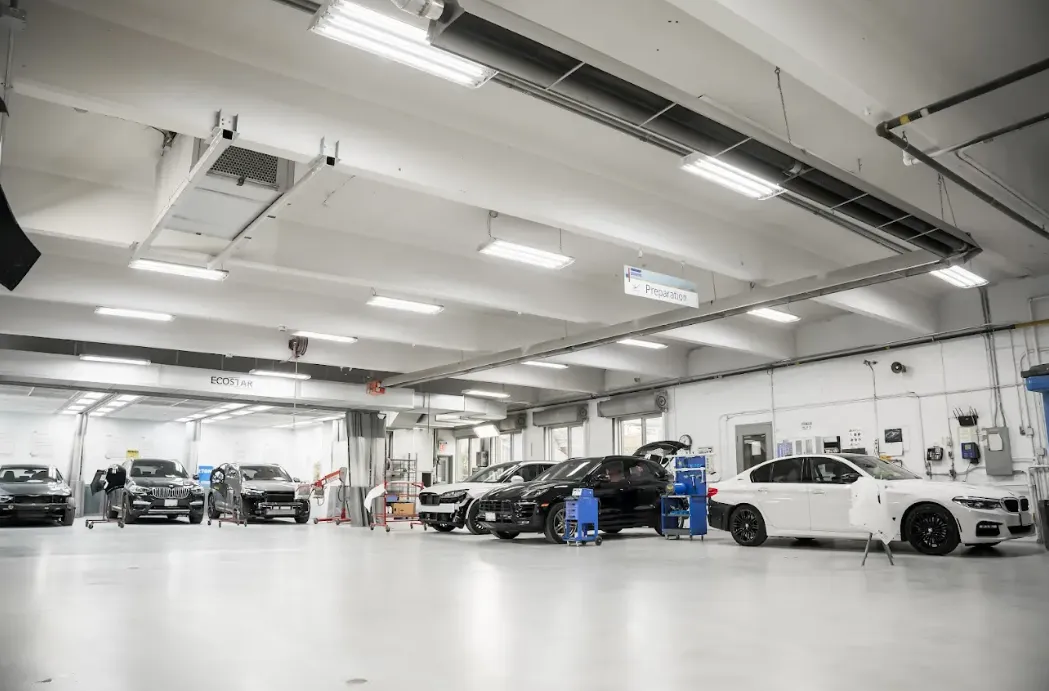
It's the last stretch of work in our 100,000 sq ft facility at 395 Evans Avenue, and it's the one owners see least. We release a car once we're confident it meets our standards, and every step of our repair process builds toward that moment. On the shop floor, that confidence is built one check at a time, first by the technicians who did the work and then by a quality-control supervisor.
When does a repair count as finished?
A repair is finished when everything the collision touched, and everything the repair touched, works and looks as it did before the hit. The looks half is the easy half to judge. A new fender can sit flush and shine like the rest of the car while the clip holding its liner, or the seal along a replaced door, is wrong in a way nobody would notice from the curb. The goal at CSN 427 Auto is pre-accident condition, and the inspection at the end is how we confirm the car got there.
That inspection runs the start of the job in reverse. In the first 48 hours of a repair, the car is taken apart and planned so hidden damage turns up early, with the parts list written down to the small clips and fasteners. Every line on that plan gets confirmed as done, and done to the OEM repair procedure, which is the carmaker's own instruction for repairing that model.
Why do some bolts go in the bin instead of back on the car?
The fastener story starts at teardown. When a car comes apart here, the electronics are unplugged and the fasteners labelled so none go missing, part of a normal day on our shop floor. The label tells a technician where each bolt came from. The repair procedure tells them whether it's allowed back in.
Torque-to-yield bolts are the best-known example of one that isn't. They're designed to stretch as they're tightened, and I-CAR, the organization that trains collision technicians, classes them as one-time-use fasteners for that reason. The stretch is part of the design, and it's also why the bolt is finished after one installation. Put one back in and it won't clamp with the same strength, and it can break or work loose down the road. You'll find them in places like cab mounts, pickup box mounts and suspension mounts. Most repair manuals skip the engineering term altogether and mark the part as one-time use.
Other fasteners are replaced for other reasons. Some have to be replaced because of a factory-applied anti-corrosion coating. And a one-time-use part that looks perfect still doesn't go back on the car. Stellantis put its rule in writing in a U.S. position statement issued in December 2025. One-time-use components are discarded once they come off and replaced with new OE (original equipment) parts, and it names clips, torque-to-yield bolts and adhesive-backed weatherstrips as examples. It adds that trim pieces with built-in fasteners can break or deform on removal and leave the trim fitting poorly. Our access to genuine manufacturer parts covers that side of the job when the procedure calls for new OE parts, and because the repair plan lists those parts from the start, they're ordered along with everything else.
Then there's torque, the twisting force a fastener has to be tightened to. The repair procedure gives a value for a long list of them, and we torque every bolt to specification as the car goes back together. I-CAR's torque-wrench video series, first published in February 2026 and updated that June, sums up the standard in one line: "Tight quarters are no excuse for loose adherence to torque specifications." It singles out steering and suspension fasteners as ones that have to be torqued correctly however awkward they are to reach.
The videos get into the problems a technician meets on a crowded corner of the car. An adapter on the end of the wrench lets it reach a buried nut, and when that adapter sits at anything other than a right angle to the wrench, the setting has to be calculated again because the leverage has changed. A strut rod nut, I-CAR's example, needs a specialty socket to torque properly. Threadlock and anti-seize get their own segment as well, since either one changes how a fastener tightens.
How are panel gaps and flush judged?
Fit is the first thing anyone notices on a repaired car, so the trade treats it as its own discipline. A panel gap is the space between neighbouring panels, such as a door and a fender or a hood and a headlamp. Flush describes whether those neighbours sit at the same height, so the surface carries across without a step. When either one is out, the car looks repaired from across a parking lot.
I-CAR's back-to-basics article on exterior panel fit-up, posted in October 2025, explains how fit is controlled on panels that get welded on. The panel is test-fitted first and held with temporary fasteners like clamps or spring clips. How it lines up with the panels and parts around it is checked before any welding, and its position is marked so it can go back in exactly the same spot after the test fit. The car should be level with its suspension loaded, or mounted on a fixture bench, while that's done. Welding methods that limit heat reduce warpage, so the weld is less likely to pull the panel out of the fit the technician just set.
The target numbers come from the carmaker where it publishes them. Some manufacturers put gap and fitment figures in the repair manual for a given model. When they don't, I-CAR says gaps and flushness can usually be compared with the other side of the vehicle, which gives the technician an undamaged reference on the same car. Fit is the first thing an owner judges a repair by, and appearance is one of the things our final inspection looks at closely.
Fit and sealing overlap more than most owners expect. Take the Jeep Gladiator. In a case I-CAR flagged, Stellantis's body repair manual warns that a replacement door can leave a slight gap between the weatherstrip channel and the inner door panel near the corners. The manual's fix is seam sealer, applied before installation to fill that gap. Nobody finds a detail like that by feel. It's in the procedure for that model, and our technicians work from the carmaker's latest procedure for the exact vehicle on the lift.
What is the test drive listening for?
The test drive waits for the electronics. The post-repair scan, which reads every control module for stored diagnostic trouble codes, and any calibration the repair calls for are done first, to the manufacturer's procedure. I-CAR puts the test drive after all calibrations, static ones done in the bay and dynamic ones done on the road, because a driver assistance system may not be testable until it's calibrated. The calibration side has its own write-up in which repairs need ADAS recalibration.
With that complete, a technician takes the car out. The drive runs at several speeds, and the technician is listening and feeling for air leaks, vibrations, noises and anything else that's off, the way I-CAR's guidance lays it out. It's a separate, final step before delivery. A dynamic calibration happens on the road too, and I-CAR is clear that the two are separate jobs.
Wind noise and rattles get particular attention. A 2022 I-CAR back-to-basics article describes using a road test to locate rattles and air leaks and to find the turbulence behind wind noise. It calls the test drive after repairs a step that tends to be overlooked, and says it should be part of every quality control check. In a separate article, validated in 2026, I-CAR lists what wind and water leaks can lead to over time, including fumes getting into the passenger compartment, dirt and dust build-up, mildew and mould, and corrosion. Prevention starts back in the body shop, with the OEM procedure followed and the right seam sealers and adhesives placed where the procedure puts them. On some repairs that includes spots that had no sealer from the factory.
Structural work adds to the drive. After frame repairs, the wheels are aligned and the car is road tested to confirm it handles as it should, which is part of how we approach structural safety after a collision. On a car with a forward camera or radar, that alignment has to be right before the calibration, because those sensors are aimed relative to the direction the car travels, and the alignment sets that direction.
Does every switch still work after reassembly?
Reassembly reconnects everything that was unplugged, from lamps to sensors behind bumpers and trim, and on many repairs the battery as well. Every part has to go back accurately fitted and working, and the final inspection that follows looks at how the car functions, how it looks, how it drives and how well it protects the people in it. In practice, functional covers the parts an owner touches every day. A lamp near the repair has to light, and a window, lock or mirror that was unplugged has to work again.
Some of this depends on the car's memory. When the battery comes off, some systems lose what they had learned, and I-CAR's battery disconnect guidance notes that some OEMs require special steps once it's reconnected. Where the procedure calls for them, the job isn't complete until they're done. Power window motors have also evolved enough that I-CAR released a training video in 2025 on the differences in newer designs and how to work with them without damaging the vehicle. A window that doesn't run the way it should is a small detail, and it's the kind we'd rather find in our bay than have an owner find in their driveway.
What happens when something doesn't pass?
The car stays in the building until it does. At CSN 427 Auto, the lead technician and a quality-control supervisor both sign off before a car moves to the delivery area, and no vehicle leaves until it passes our internal audit. That second sign-off puts a fresh set of eyes on every car before it goes home.
Checks don't wait for the end, either. When a car moves from body work to paint, the body technician and the painter inspect it together, so anything that needs another look is raised before colour goes on. I-CAR's quality control guidance, first published in 2010 and validated in 2025, makes the case for that rhythm. A checklist gives the technician a structure for every step a quality repair needs. I-CAR recommends one that a manager or quality control technician signs off before the vehicle moves to the next department, and its sample checklist has a space the manager initials to confirm any issues were corrected.
Checking at each stage, I-CAR says, reduces compounding rework, where fixing one problem found late means redoing finished work built on top of it. The trade's word for the worst case is a comeback, a car that returns after delivery with an issue, and the checklist exists to prevent both.
As an example, and not a real customer's car, say an SUV with a replaced rear door comes back from its test drive with a faint whistle at highway speed noted on the sheet. Under a checklist system like I-CAR's, that note goes back to the body side, the door's fit and weatherstrip are checked against the procedure, and the car goes out again. The initials confirming the correction go on the sheet before it moves on. Our manufacturer certifications add an outside layer to all of this, since each one requires passing rigorous factory inspections and nothing is self-reported.
How do the paint and the cabin get their last look?
The paint has a final stage of its own. In our paint department, the last step is buffing, polishing and any touch-ups, and then a technician gives the finish a final inspection. On gloss finishes, the repaired panels should shine to match the original paint around them.
For complex colours, our painters spray test cards and view them under different lighting before the car is painted. Painters judge colour in more than one kind of light because of metamerism, the trade's name for two finishes that match under one light source and drift apart under another. Trade guidance has long treated daylight as the reference every other light is judged against, and notes that fluorescent tubes exaggerate some mismatches and hide others. Blend panels, where colour is carried into an undamaged neighbouring panel so the side looks like one continuous colour, get the same last look as the panel that was repaired. Blending is covered in how our paint department works, and our piece on how complex colours are matched explains the formula side.
The cabin gets attention too. Our technicians list interior cleaning in the last quality control phase, alongside polishing and the road test, so the inside of the car comes back as finished as the outside.
What goes into the repair file?
A finished repair leaves paperwork behind. In June 2026, AIA Canada described I-CAR Canada's Post Repair Process course, which covers the steps after the repair work ends. The records it discusses include pre- and post-scan reports, technical data sheets, sublet documentation and final repair bills. Sublet is work done by an outside specialist, and technical data sheets are the mixing and application instructions refinish makers publish for products such as primer, basecoat and clearcoat. The course also teaches students to compare the completed repair against the final estimate, to reconcile invoices and to verify the documents that support them.
Our own process closes the job the same way. Where a car needed a calibration or a post-repair scan, we confirm that work was completed and verified, and on structural work every repair is documented. Our appointment checklist covers what that means for you at pickup. Records like these are what a repair file is built from.
What happens at pickup, and after?
When the car is ready, we go over the repair with you, walk you through the work and take your questions. The same AIA Canada article makes the point that vehicle delivery is more than simply returning keys, and the course covers coordinating the delivery appointment and reviewing paperwork and warranty information with the customer. Our warranty on repairs is part of that conversation.
A few days after delivery, we call to make sure you're happy with the repair and to answer any questions that have come up since. The Post Repair Process course names following up after delivery as one of the habits that build stronger customer relationships. If you're wondering where the days go across a whole repair, this final stage included, what drives repair timelines breaks it down.
Questions about the final inspection
Why would a bolt that looks fine be replaced?
Some are designed for one installation. A torque-to-yield bolt stretches as it's tightened, and I-CAR's guidance is that one-time-use parts and fasteners that look uncompromised still shouldn't be reused. The repair procedure for the car identifies them, so the bolt's appearance never comes into it.
Can a collision repair cause wind noise or a water leak?
It can when seals, sealers or panel fit aren't right, so the test drive listens for it. I-CAR ties prevention to following the OEM procedure and placing seam sealers and adhesives where that procedure calls for them. At CSN 427 Auto, the road test is part of the last quality control phase, before the car can clear our internal audit.
Does a minor repair get the same final checks?
It goes through the same final stage, sized to the work that was done. A scuffed bumper cover still has clips, fasteners and fit to check. If a camera or sensor sits behind it and the work disturbs it, it's calibrated before we hand the keys back.
Who decides the car is ready?
Two people. The lead technician who ran the repair signs off, and so does a quality-control supervisor, before the car moves to the delivery area. Until both have, the car stays in the shop.
Do trucks and vans get the same treatment?
Commercial vans and light-duty trucks go through our dedicated 13,000 sq ft truck shop, where we handle the collision-related mechanical work and full calibrations that bring them back to pre-accident condition. Our post inside the truck and van repair facility shows how that building works.
When your car needs a repair, we want to be the shop that signs it off. Book your estimate online or call us at 416-259-6344. You'll find us at 395 Evans Avenue in Etobicoke, open Monday to Friday from 7:30 a.m. to 5:30 p.m. and Saturday from 9:00 a.m. to 1:00 p.m.