

If you hit a deer in Ontario this fall, you're in busy company. Ontario Provincial Police in the central region have reported that most of their wildlife collisions happen between October and December, and that 85.5 per cent involve deer. The clocks went back on November 1, so the drive home from the city now runs through dusk, when the province's driver's handbook says wild animals are most active. For drivers on the 427, the 401, the 407 and the highways north to cottage country, the next few weeks are peak season. If it happens to you, what you do at the roadside shapes the claim, and the repair is where a modern car surprises most owners.
How common are deer collisions in Ontario?
The Ministry of Transportation counts them in its annual road safety report, and the numbers are large. In 2022, the latest year with final figures, 12,272 vehicles were involved in police-reported collisions where the first impact was a wild animal. That's nearly four times the number of vehicles whose first impact was a pedestrian. Almost all of those animal collisions, 11,949 of them, caused property damage only, with no injury. The ministry's handbook adds that many of these collisions go unreported, so the real number is higher.
Deer aren't only a rural problem either. The City of Toronto lists deer among the urban wildlife its animal services respond to, alongside the raccoons and coyotes most people expect.
What should you do right after hitting a deer?
Get the car and yourself out of harm's way first. Pull over somewhere safe and turn on your hazards. Keep away from the animal. The Ministry of Transportation's handbook says not to try to move an injured animal, and CAA puts it plainly: you may want to help, but injured wild animals are dangerous. Keep well back from passing traffic as well, because a dark highway shoulder is a risky place to stand.
Then call it in. The driver's handbook tells drivers who hit a deer or moose to report it to the local police service or the Ministry of Natural Resources. If the collision happened on a 400-series highway, including the 427 and the 401, Toronto Police direct drivers to the Ontario Provincial Police. Inside Toronto, an injured animal on a road or expressway can be reported to Toronto Animal Services through 311, and the City removes large dead animals from City property.
Once it's safe to do so, take photos of the damage and the scene for your insurer, without stepping into traffic to get them.
Do you have to report hitting a deer to police in Ontario?
The reporting rule in the Highway Traffic Act applies to any collision that injures someone or causes property damage that appears to exceed the amount set by regulation, and it doesn't carve out animals. That amount changed on January 1, 2025. It's now $5,000 in combined damage, up from $2,000, and plenty of older wildlife guides online still quote the old figure.
On a modern car, that line isn't hard to cross. In the U.S., AAA's 2023 study found that replacing driver-assist parts alone averaged about US$1,540 in a minor front collision, on repairs that averaged close to US$11,700 overall. If someone is hurt, report it to police, whatever the damage looks like.
In Toronto, reportable collisions that police don't attend are reported at a Collision Reporting Centre, and Toronto Police say any vehicle towed from a collision scene must go directly to a reporting centre first. Our guide to collision reporting centres in Toronto has the locations, hours and what to bring.
Which insurance coverage pays for hitting a deer?
For most drivers, a deer strike is a comprehensive claim. The standard Ontario auto policy doesn't mention animals anywhere. It describes comprehensive as paying for losses other than those covered by collision or upset, and the insurance industry treats a collision with a live animal as one of those losses. The Insurance Bureau of Canada told Money.ca in November 2026 that an animal causing damage to a vehicle would be a comprehensive claim.
A few details change the picture:
- The animal was already dead. Insurers including Belairdirect and Allstate treat hitting a deer that was already lying on the road as a collision with an object, which goes under collision coverage and can count as at fault.
- You swerved and hit something else. If you missed the deer and struck a guardrail, a tree or another car, that's generally handled as a collision claim, and a crash with another car runs through Ontario's fault rules like any other. Your broker can confirm how your own insurer treats it.
- You don't carry comprehensive. Comprehensive and collision are optional in Ontario. Direct Compensation Property Damage, the coverage that pays for your car when another driver is at fault, only applies when at least one other insured vehicle is involved, so it doesn't apply to a deer. Without comprehensive or all perils, the damage to your own car isn't covered.
The comprehensive deductible applies each time you claim. The standard policy asks you to notify your insurer in writing within seven days, to protect the car from further damage, and not to make repairs beyond that protection without the insurer's written consent. That makes the first call to your insurer or broker an early step, before the repair starts. You also get to choose where your car is repaired, and Toronto Police say so plainly on their own collision reporting page. Our insurance partners page explains how direct billing works with the insurers we're approved by.
If anyone was hurt, accident benefits apply regardless of who caused the collision. The mandatory benefits changed for policies written on or after July 1, 2026, which we covered in our post on Ontario's 2026 auto insurance changes.
This section is general information, not insurance or legal advice. Your own policy wording and your insurer or broker decide how a specific claim is handled.
What does a deer do to the front of a modern car?
It hits the part of the car most densely packed with sensors. On most cars with adaptive cruise and automatic emergency braking, the forward radar sits right behind the grille or the brand emblem. Honda Canada describes its radar as mounted directly behind or below the front emblem. On some Toyotas the emblem itself is part of the radar system, and back in 2016 the radar-equipped emblem for a 2015 Camry listed at about US$965 in the U.S., against about US$51 for the standard one.
A typical deer strike can involve some or all of these:
- the bumper cover, its energy absorber and the reinforcement behind them
- the grille or emblem and the radar sensor and bracket behind it
- one or both headlamps, which on newer cars are LED or adaptive units with their own aiming requirements
- the hood, hinges and latch, and the fenders on a wider hit
- the A/C condenser and radiator sitting right behind the grille
- active grille shutters, front parking sensors and, on some cars, a front camera in the bumper
- the windshield, if the animal rolled up the hood, and the camera mounted behind it
Cooling parts deserve particular care. Repairer Driven News has reported condensers and radiators among the parts most often damaged in front hits, along with an A/C specialist's rule that any bend in an A/C line means replacing it. The same report notes that moisture getting into the system can break down the oil and form acid.
Much of a deer's damage is hidden. A Minnesota collision repairer told Autobody News in December 2024 that deer collisions often involve subtle damage that can be easy to miss. A bumper cover can spring back into shape while the bracket holding the radar behind it has shifted. We take the front apart to find that before the repair plan is set, and our post on why bumper damage isn't always cosmetic shows what sits behind the cover.
Can hitting a deer set off the hood?
It can on cars that carry a pedestrian protection system, sometimes called an active or pop-up hood. On those cars, sensors in the front of the car detect the impact and small pyrotechnic charges at the rear of the hood fire, lifting it to put more space between the hood and the hard parts underneath. On the 2018 Buick Regal, the system lifted the rear of the hood about four inches.
The system can't always tell a person from an animal. Tesla's European owner's manual says the Active Hood may deploy if the car collides with an animal, and a BMW owner's manual for European models lists a collision with an animal among the impacts the system can't rule out as a pedestrian. Which models carry these hoods in Canada varies by brand, model and market, so the system on your car depends on how it was built.
Once it fires, it's a parts job. Mercedes-Benz repair information for the AMG GT 4-door Coupe, published through I-CAR, lists the pyrotechnic hood lifter among the parts that must be replaced after a deployment, and states that damaged pyrotechnic components, control units and their sensors must always be replaced and may not be repaired. Tesla's manual says the system's sensors and actuators must be serviced whenever it has deployed. If your hood has popped up after a deer strike and you can't see clearly over it, or the latch is damaged, the car needs a tow.
What do manufacturers require after a front-end hit?
Each brand writes its own rules, and they've become very specific. A few examples from brands we're certified to repair:
- Toyota owner's manuals list radar recalibration whenever the front bumper or grille has been replaced, and say the radar sensor and its cover must not be painted or modified and must be replaced only with genuine Toyota parts.
- Honda Canada requires the front radar to be aimed after any bumper repair within 300 mm of the sensor, after the radar has been removed and reinstalled, or after an airbag deployment, and calls for a four-wheel alignment check when a collision makes aiming necessary.
- Porsche doesn't allow paint on bumpers in the radar transmission area or plastic welding of cracks there. If a repair would affect the sensors, the bumper is replaced.
- Audi says that on cars with adaptive cruise control, the trim in front of the radar on the right side of the front bumper must not be painted during a repair, because the extra paint layer can stop the system working.
- Tesla doesn't allow repairs in the radar area and caps paint thickness there at 300 microns.
- Mercedes-Benz owner's manuals, including the EQE SUV's, tell owners to have the sensors checked by a qualified workshop after any impact that damages the bumper or the radiator grille.
Those rules decide most of a deer repair before a panel is touched. Whether a bumper cover is repaired or replaced, whether it can be painted and by how much, and which calibrations follow all come from the manufacturer's procedure for that exact car. We work from that information and from access to genuine manufacturer parts, and every calibration the procedure calls for is completed before the car is handed back. Calibration is part of nearly every front-end repair on a newer car, for the reasons laid out in which repairs need ADAS recalibration. Being certified by the brands themselves, including Toyota, Honda and Porsche, is how we have their tools and repair procedures in the building.
For Mercedes-Benz owners in particular, the radar bumper, the paint limits around the parking sensors and the calibrations are covered in our Mercedes-Benz repair guide.
Is a deer strike different on an electric car?
On an electric car, the space behind the front bumper holds the cooling hardware for the battery, the cabin heat pump and the A/C, and on many models a front trunk. A deer that pushes the condenser back on an EV can touch the system that keeps the battery at temperature.
The repairs reflect that. Tesla's service procedure for replacing the condenser on a Model Y includes refilling the coolant under vacuum, recharging the A/C and running dedicated heat pump and thermal system test routines before the job is done. Mercedes-Benz tells EQE SUV owners to have the vehicle transported away after an accident and not to touch any high-voltage components. A front-end hit on an EV is a tow and an inspection, even when the car still seems to drive.
Should you drive the car after hitting a deer?
Often you shouldn't, and the call is easier than it seems at the side of the road. Call a tow if any of these apply:
- the hood won't latch, has lifted, or blocks your view
- a headlamp is out or pointing the wrong way, especially at night
- fluid is dripping, or the temperature gauge or a warning light comes on
- an airbag has deployed
- the car is an EV with damage to the front end
If none of those apply and you're unsure, call us before you drive it and we'll tell you whether it should come in on a truck. Our roadside towing line covers the Greater Toronto Area around the clock at 416-727-5066. Inside Toronto, remember the reporting centre comes first for any car towed from a collision scene, and we take it from there.
Questions about hitting a deer in Ontario
Will my insurance go up after hitting a deer?
A collision with a live animal is generally treated as a comprehensive claim and not at fault. Belairdirect, for example, says such a claim should not affect your premium. How any claim shows up in your history and future rating is a question for your own broker or insurer.
Is hitting a deer an at-fault accident in Ontario?
Usually it isn't. Insurers generally treat a strike on a live animal as not at fault. Hitting a deer that was already dead on the road is usually handled as a collision with an object, which can count as at fault, and so can swerving into something else.
How long do I have to tell my insurer?
The standard Ontario policy asks for written notice within seven days of the incident. Calling your broker or insurer the same day or the next morning is simpler, and it lets the claim and the repair start together.
Is it better to brake or swerve for a deer?
The Ministry of Transportation's advice is to slow down, sound your horn and not try to drive around the animal, because its movements are unpredictable. Ontario Provincial Police have said it's safer to brake firmly than to swerve. A Traffic Injury Research Foundation study of fatal wildlife collisions in Canada found that one in three was caused by drivers swerving. The ministry also warns that other animals may be travelling with the one you've seen.
Can I choose where my car is repaired after a deer strike?
Yes, you can. The choice of body shop is yours. We work with most major insurers as an approved repair shop and can bill them directly, so the claim and the repair move together.
Does a small bumper scuff from a deer need a calibration?
It depends on where the scuff is and what the manufacturer says. Honda, for example, requires radar aiming after any bumper repair within 300 mm of the sensor, and Toyota requires recalibration whenever the bumper or grille is replaced. A scuff over the radar area can also be one the manufacturer won't let us repaint at all, which turns it into a new bumper cover.
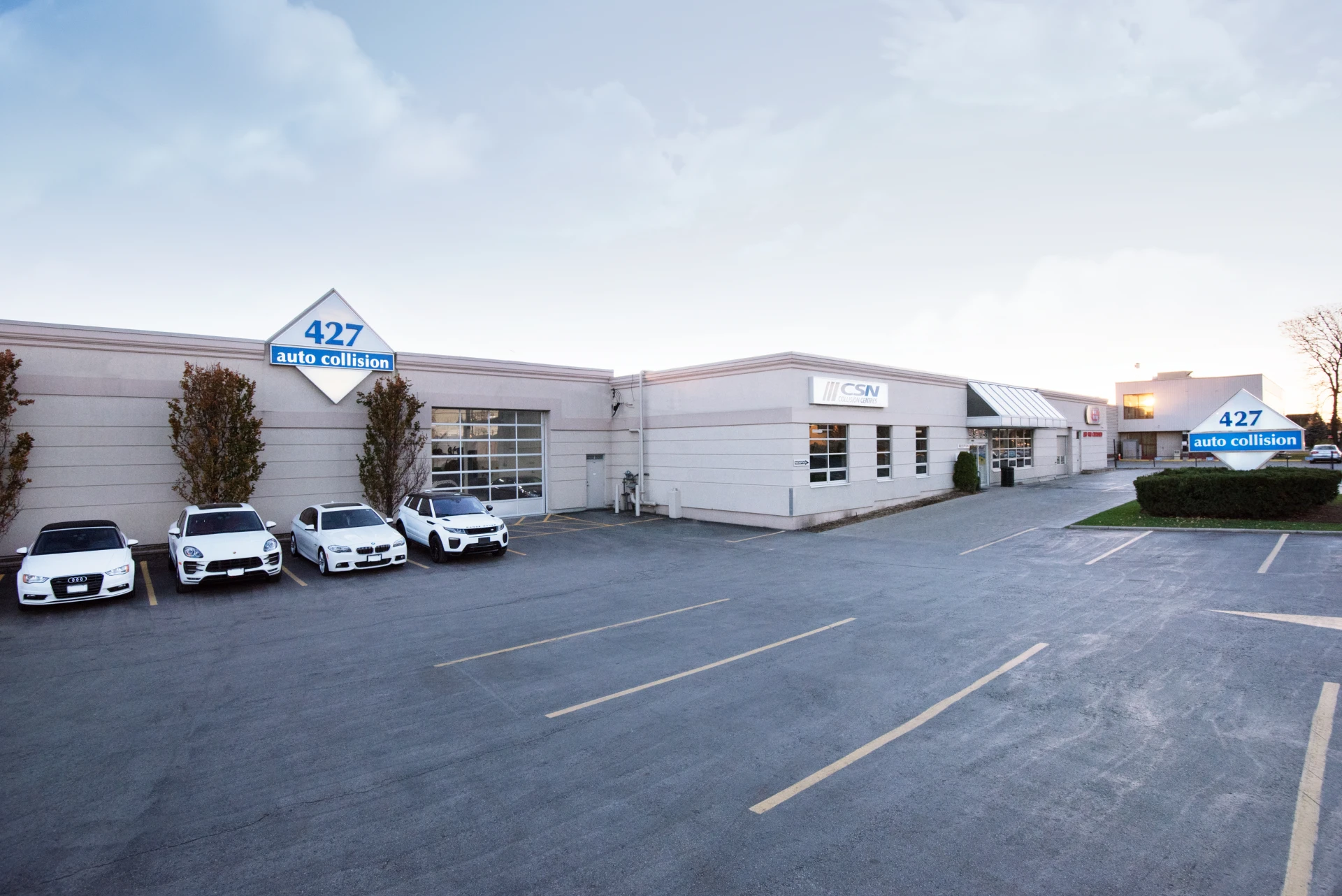
If a deer has left its mark on your car this fall, we'll take it from the roadside back to pre-accident condition. Call our 24/7 roadside towing line at 416-727-5066 if the car shouldn't be driven, or book your estimate online and call us at 416-259-6344. We're at 395 Evans Avenue in Etobicoke, just off the 427, open Monday to Friday from 7:30 a.m. to 5:30 p.m. and Saturday from 9:00 a.m. to 1:00 p.m.